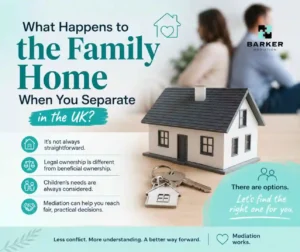
When a relationship breaks down, one of the first worries people have is simple but heavy: what happens to the house?
It’s rarely just about money. That space holds memories, routines, and for many, it’s where children feel safe and settled. So it’s completely normal for this question to feel emotional as well as practical.
The truth is, there isn’t a single clear-cut answer. Every situation is different. Things like who owns the property, how finances have been handled over the years, what both people need moving forward, and whether children are involved all play a part. See Here: How Does Family Mediation Help With Child Arrangements After Separation West Midlands?
This is where mediation can really help take some of the pressure off. Rather than handing decisions over to a court, mediation gives you both the chance to sit down and talk things through properly. It’s not about arguing or “winning”—it’s about understanding what matters to each of you and finding a way forward that feels reasonable on both sides.
With a neutral mediator guiding the conversation, things often feel calmer and more focused. You can look at your options, ask questions, and take the time you need to make decisions that actually work in real life—not just on paper.
At Barker Mediation West Midlands, the aim is to make these conversations easier, not harder. It’s about helping you reach an agreement that feels fair, practical, and allows both of you to move forward with less stress.
Is the House Always Split 50/50?
This is one of the most common assumptions — and also one of the biggest misconceptions.
In reality, a house is not automatically divided equally. See Our Financial Mediation West Midlands on Separation: Property, Pensions and Debt
Instead, decisions are based on what is considered fair, not strictly equal. Several factors come into play, including:
- Each partner’s income and financial situation
- Contributions to the property (deposit, mortgage, renovations)
- The needs of any children involved
- Future earning potential
- Age and health of both parties
In short, fairness depends on your unique circumstances, not a fixed formula.
Who Has the Right to Stay in the House?
One of the questions people ask straight away during a separation is: who stays in the house?
In reality, there isn’t a simple answer. Yes, legal ownership matters—but it doesn’t automatically decide everything.
For example, if there are children, it’s quite common for the parent who looks after them most of the time to stay in the home, mainly to keep things as normal and settled as possible for them.
Other things that are usually considered include:
- Whose name is on the mortgage or property title
- Who can realistically afford to keep the home running
- The safety and wellbeing of both people
There are also situations where both partners have the right to stay in the property, at least for a while. It might not feel ideal, but it does happen, especially in the early stages.
This is often where things can start to feel tense. Instead of it turning into an ongoing disagreement, mediation gives you both the chance to sit down and talk it through properly. With the right support, it becomes easier to look at what’s fair, what’s realistic, and what’s going to work in the long run for everyone involved.

What Are the Main Options for Dividing a House?
When it comes to dividing a property, there are several common routes couples can take:
- Selling the Property: The house is sold, and the proceeds are divided between both parties. This is often the cleanest break financially.
- One Person Buys the Other Out: One partner keeps the home by paying the other their share. This usually involves refinancing the mortgage.
- Deferred Sale (Mesher Arrangement): The sale is postponed—often until children reach a certain age—so they can remain in the home.
- Shared Ownership for a Period: Both partners retain an interest in the property for a set time.
Each option has its pros and cons. Mediation helps you weigh these carefully, so you’re not making rushed or emotionally driven decisions. Is Mediation Right for Every Family? Domestic Abuse, Safeguarding and Power Imbalances
How Are Financial Contributions Considered?
It concerns a lot of people who worry about whether their financial stake in the home will be acknowledged.
Although deposits, mortgage payments, and renovations are certainly contributions, they aren’t the only things considered. Courts — and mediators West Midlands — also take a broader view, including:
- Each person’s current financial situation
- Future earning potential
- The needs of any children
- Length of the relationship
That means the result isn’t a simple “who paid what” computation.
During mediation, both sides can express their inputs and expectations. This usually results in more balanced and realistic settlements than a fixed legal approach.

What Happens If You Can’t Agree?
Not every discussion ends with an immediate agreement — and that’s totally normal.
If you’re having trouble getting on the same page, mediation creates a safe space to decelerate and work through sore spots. A mediator doesn’t take sides but facilitates the discussion so both individuals feel heard.
But if there is still no resolution, the next step may be legal action. It can take more time, money, and be less fun or stressful.
That’s why, in mediation West Midlands, many couples prefer to go first. Even if such agreements are only partial, they still limit the issues on which disputes can arise later.
How Mediation Helps Couples Reach Fair Agreements
Mediation isn’t about dictating decisions — it’s about setting an environment for constructive conversations.
The process is designed at Barker Mediation West Midlands to:
- Reduce conflict and tension
- Encourage open, honest communication
- Focus on practical solutions
- Get decisions into your hands, not in the court’s
The flexibility is one of the most significant benefits. Mediated agreements do not have to be one-size-fits-all like court orders; they can be created with your specific situation in mind. How to Avoid Family Court During Divorce in the UK West Midlands
It is also usually faster and cheaper, so that you can move on more quickly rather than getting bogged down in a lengthy legal process.
When Mediation Might Not Be Suitable
Though mediation works for many couples, it’s not for all of them.
For example, it may not be suitable if:
- You have a history of abuse or intimidation
- One person thinks it’s dangerous or impossible to be honest
- This is a total lack of trust and no willingness to talk
In such cases, alternative forms of legal redress may be more effective along with balancing safety and fairness.
Before embarking on mediation, any reputable mediation service will vet whether mediation is applicable. Your wellbeing comes first.

Common Questions Clients Ask
Q: I can’t agree with my partner on what to do with our house during separation. What should I do first?
The most important thing is to collect all financial information about the property, and not make hasty decisions. Mediation is often the most effective first step that allows both sides to explore options in an orderly, calm and cost-effective manner.
Q: Can mediation even help us figure out what to do with the house if we’re both feeling so emotional between each other?
Yes, mediation is for high-conflict situations. A go-between focuses conversations and enables both parties to relate more productively.
Q: My partner’s name is on the house. If we separate, do I have any rights to stay in the property?
You might still have rights, particularly if it’s your family home or you are married. That you don’t have options is not a foregone conclusion.
Q: What’s the fairest way to split the house if one of us paid most of the deposit or mortgage?
Fairness isn’t only about who paid more. During discussions, considerations also include future needs and children.
Q: Should we sell the house right away, or reconsider selling a little longer West Midlands?
It depends on your situation. Selling provides a clean break, while waiting offers some stability — particularly for kids.
Q: What if one wants to keep the house but can’t afford to buy out the other now West Midlands?
You might settle on a delayed buyout or eventual sale. Mediation can help create flexible solutions that will work for both parties.
For Further Information, please Call Us ON 03300 100 151